
An organization commissions a penetration test. The report identifies a flaw in an account-recovery flow. Developers fix it, the security team adds a test, and the issue is closed.
That is a useful outcome—but it is not the whole story.
Could the flaw have been found earlier, while the feature was being designed? Would monitoring have noticed someone abusing it? If an account had already been taken over, could responders determine which records were accessed? And would the evidence still be reliable enough to support a careful investigation?
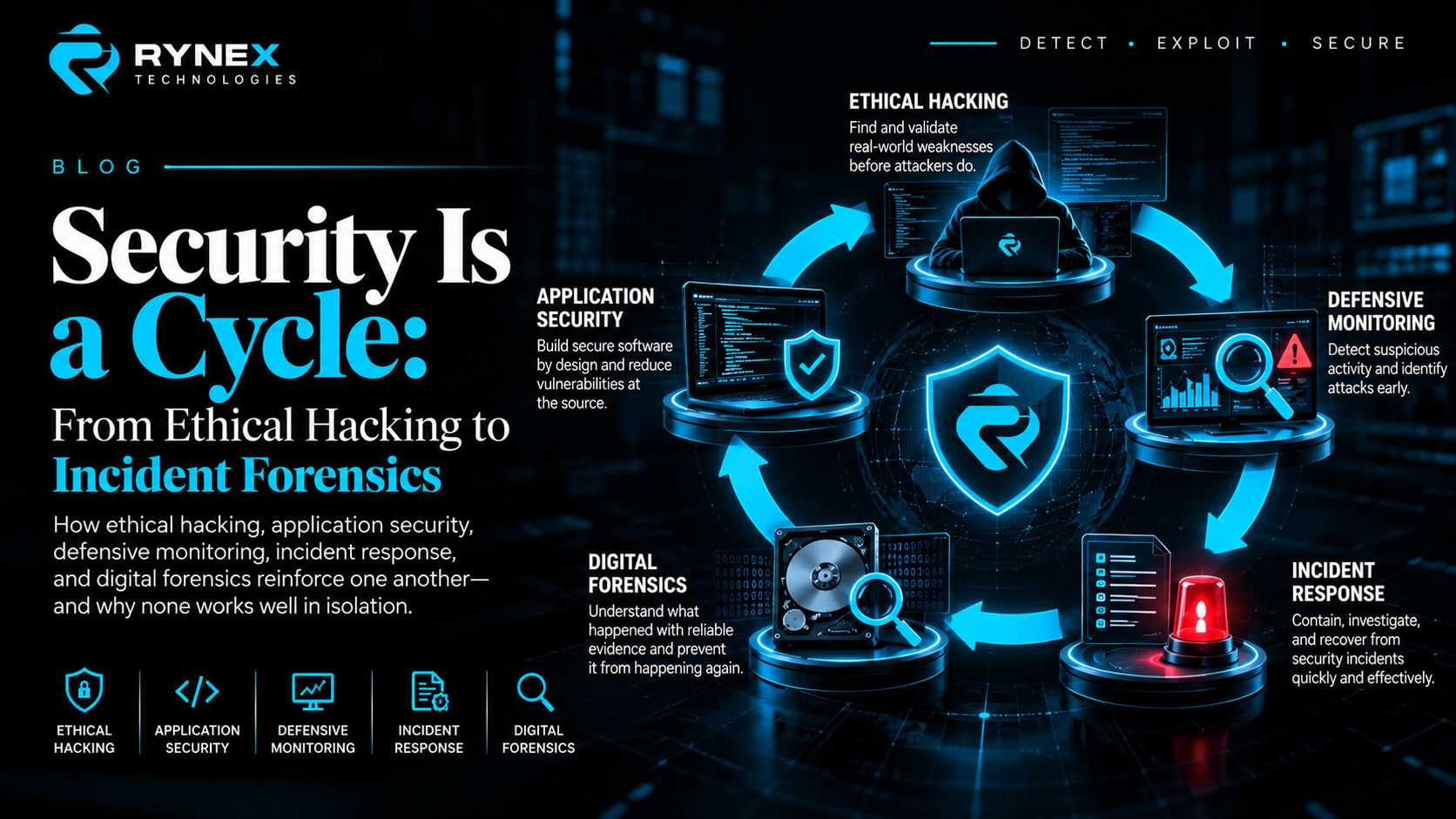
Those questions connect five areas that are often treated as separate jobs: ethical hacking, application security, defensive monitoring, incident response, and digital forensics. In practice, they are parts of a continuous security cycle. Each one discovers information the next can use, and each one improves when it receives feedback from the others.
What's inside
- Five disciplines, one mission
- A vulnerability's journey through the security cycle
- What each discipline needs from the others
- The guardrails that make the cycle trustworthy
- How to start building the feedback loop
- Key takeaways
- Sources and further reading
Five disciplines, one mission
These specialties ask different questions, but they share the same goal: reduce harm to people and the systems they depend on.
| Discipline | The central question | Typical contribution |
|---|---|---|
| Ethical hacking | How could an attacker exploit a weakness within the agreed scope? | Demonstrates and prioritizes attack paths before they cause real damage. |
| Application security | How do we prevent vulnerabilities from entering or surviving in software? | Builds security into design, code, dependencies, testing, and release processes. |
| Defensive monitoring | What is happening in our environment, and what looks unusual? | Collects and analyzes useful signals from applications, identities, endpoints, and networks. |
| Incident response | What should we do when we suspect a security event? | Coordinates investigation, containment, communication, recovery, and follow-up. |
| Digital forensics | What happened, how do we know, and what evidence supports that conclusion? | Preserves and analyzes artifacts in a reproducible, appropriately documented way. |
They are not interchangeable. A penetration test is not an incident-response plan. A monitoring alert is not proof of a compromise. A forensic examination cannot recover evidence that was never retained. And a secure coding checklist cannot replace testing the deployed system.
The value comes from connecting them.
A vulnerability's journey through the security cycle
Consider a fictional service that lets customers reset a forgotten password. The service issues a recovery token, but the token is not reliably invalidated after use.
1. Application security reduces the chance of the flaw
The best time to address a security weakness is before it reaches production. During design, a team can define what a recovery token must guarantee: it should be unpredictable, expire, be bound to the intended account and action, and become unusable after successful redemption.
Those expectations can become implementation requirements, code-review questions, and automated tests. The application-security team can help developers model abuse cases, use well-understood libraries, and verify that the behavior is enforced on the server—not merely hidden in the interface.
This does not mean every developer must become a penetration tester. It means security expectations are part of the feature definition, just like reliability and accessibility.
2. Ethical hacking tests the assumptions
Once the feature exists, an authorized tester checks whether the real service behaves as intended. They might examine whether tokens can be reused, whether one account's token affects another account, or whether the recovery flow exposes sensitive information.
The word authorized matters. Ethical testing has an agreed target, scope, time window, permitted techniques, and rules for handling data. The objective is to validate risk safely—not to access more information than needed or disrupt real users.
A useful finding explains the condition, demonstrates it with the minimum necessary proof, identifies the likely impact, and gives the team enough detail to reproduce and fix it. It should also make clear what was not tested. That keeps a technical observation from turning into an unsupported claim.
3. Defensive monitoring looks for abuse
Even a well-tested application can contain defects. Monitoring asks whether attempts to exploit them are visible.
For the recovery flow, useful signals might include unusual token-redemption patterns, repeated failures across many accounts, recovery followed immediately by sensitive account changes, or requests from an unexpected service or region. These signals should be evaluated in context: a burst of failed requests may indicate an attack, a broken client, or a legitimate support event.
Good monitoring is not simply collecting as much data as possible. It is collecting the right data, protecting it, keeping it for a justified period, and making it usable by the people who investigate alerts. An alert that nobody can interpret—or that fires constantly without action—is not effective detection.
4. Incident response turns a signal into decisions
Suppose monitoring flags a suspicious sequence of password resets. Incident responders need a practiced way to answer several questions:
- Is this a security incident, a false alarm, or still uncertain?
- Which accounts, services, and data may be affected?
- What can be contained without causing unnecessary harm to customers?
- Who needs to make decisions, and who needs to be informed?
- What evidence should be preserved before systems or credentials are changed?
Containment is not always as simple as shutting a server down. That could destroy volatile evidence or interrupt an essential service. In another situation, leaving the service online could allow ongoing abuse. Responders balance those risks using the organization's incident plan, business context, and available evidence.
5. Digital forensics supports a defensible account
Forensics helps establish what happened from available artifacts: application logs, identity-provider events, database records, endpoint telemetry, cloud audit trails, backups, or preserved system images.
The work should be repeatable and documented. Investigators record where evidence came from, when and how it was collected, who handled it, and what transformations or analyses were performed. Hashes can help detect changes to acquired files, but a hash alone does not prove that the original collection was complete or that the source was trustworthy.
The aim is not to claim certainty where the evidence does not support it. A careful report distinguishes observed facts, reasonable inferences, gaps, and unresolved questions. That distinction matters for technical remediation, customer communication, legal review, and future investigations.
6. Lessons return to engineering and testing
After the incident—or after a successful exercise—the cycle continues. The team might change token handling, add a regression test, improve alert context, shorten a detection gap, update its response playbook, or retain a specific audit event for a justified period.
The important measure is not whether the organization produced a report. It is whether the system became harder to exploit, easier to monitor, and safer to recover.
What each discipline needs from the others
The cycle only works when teams share useful information. That does not mean unrestricted access to every log, exploit detail, or customer record. It means creating a deliberate path for knowledge to move.
Ethical hacking needs realistic context
Testers need an accurate asset inventory, clear authorization, and an understanding of important workflows. Without that context, they may focus on technically interesting issues while missing the paths that matter most to the business or its users.
They also need a route for urgent findings. If a test uncovers active exposure or a risk that cannot safely wait for the final report, the escalation process should already be known.
Application security needs evidence from production
Design reviews and test suites cannot anticipate every configuration, integration, or usage pattern. Incident trends and monitoring data can reveal which assumptions fail in the real environment. Those lessons can become better requirements and more relevant tests.
Monitoring needs to understand the application
An alert is more useful when it describes the affected account or workflow, includes a reliable event identifier, and can be correlated with identity and infrastructure events. Application teams can explain which behaviors are normal and which actions should be logged—without logging passwords, session tokens, or unnecessary personal data.
Incident response needs rehearsed ownership
Responders should know who can disable a credential, isolate a service, preserve a cloud snapshot, or contact a vendor. Those actions should not have to be invented during a high-pressure incident. Tabletop exercises can reveal unclear authority and missing dependencies before a real event does.
Forensics needs preparation before an incident
Evidence quality depends on decisions made in advance: synchronized clocks, appropriate log retention, stable identifiers, protected backups, documented collection procedures, and access controls. If an organization waits until after an incident to decide what it should have recorded, some questions may no longer be answerable.
The guardrails that make the cycle trustworthy
Security work is powerful, so its process matters as much as its technical skill.
Authorization and scope. Offensive testing should have explicit permission and defined boundaries. If the target, technique, or data handling falls outside those boundaries, stop and obtain approval rather than assuming consent.
Data minimization. Use test accounts and synthetic data where possible. When real information is encountered, collect only what is needed to demonstrate the issue, protect it, and follow the agreed retention and deletion rules.
Least privilege. Give testers, analysts, and responders access appropriate to their responsibilities and time-bound where practical. Emergency access should be controlled and reviewed.
Evidence integrity. Document collection and handling. Preserve originals where appropriate, analyze verified copies, and avoid altering systems before considering the investigative impact.
Honest uncertainty. Logs can be incomplete, clocks can drift, and multiple explanations can fit the same evidence. State confidence and limitations clearly. A plausible story is not the same as a proven one.
Learning without blame. Blame discourages people from reporting mistakes and near misses. Accountability still matters, but the first question should be how the process allowed the failure and how to make recurrence less likely.
How to start building the feedback loop
An organization does not need a large security department to start connecting these disciplines. A few practical steps create momentum:
- Choose one important workflow. Account recovery, payment approval, file sharing, or administrative access are good places to begin.
- Map its security expectations. Identify the data and users involved, define who is allowed to do what, and write down the failure modes that would matter.
- Test the workflow safely. Use a scoped assessment or focused review, and turn verified findings into actionable engineering work.
- Decide what evidence the workflow should produce. Record security-relevant events with consistent timestamps and identifiers while minimizing sensitive data.
- Write a response path. Specify who triages a suspicious event, who can contain it, how evidence is preserved, and how affected people are considered.
- Exercise the path. Walk through a realistic scenario. Note delays, missing logs, unclear ownership, and assumptions that fail under pressure.
- Feed the lessons back. Improve the feature, tests, alerts, playbooks, and evidence-retention decisions. Then verify that the improvements work.
Start small and repeat. A well-understood workflow with a tested response path is more valuable than a collection of disconnected tools and policies.
Key takeaways
- Ethical hacking, application security, monitoring, incident response, and forensics solve different parts of the same problem.
- Prevention is essential, but it cannot guarantee that incidents will never happen. Detection and recovery matter too.
- Monitoring and forensics depend on application teams producing useful, privacy-conscious telemetry.
- Incident response works best when roles, containment options, and evidence procedures are prepared in advance.
- Authorized testing, evidence discipline, data minimization, and honest statements of uncertainty make security work more trustworthy.
- Every test and incident should improve the next design, detection, response, or recovery effort.
Security is not a handoff from one team to another. It is a loop: test what you build, observe what runs, respond when something goes wrong, learn from the evidence, and use those lessons to build something safer.
Sources and further reading
- NIST SP 800-115: Technical Guide to Information Security Testing and Assessment
- NIST SP 800-218: Secure Software Development Framework (SSDF)
- NIST SP 800-61 Rev. 3: Incident Response Recommendations and Considerations
- NIST SP 800-86: Guide to Integrating Forensic Techniques into Incident Response
- OWASP Application Security Verification Standard (ASVS)