
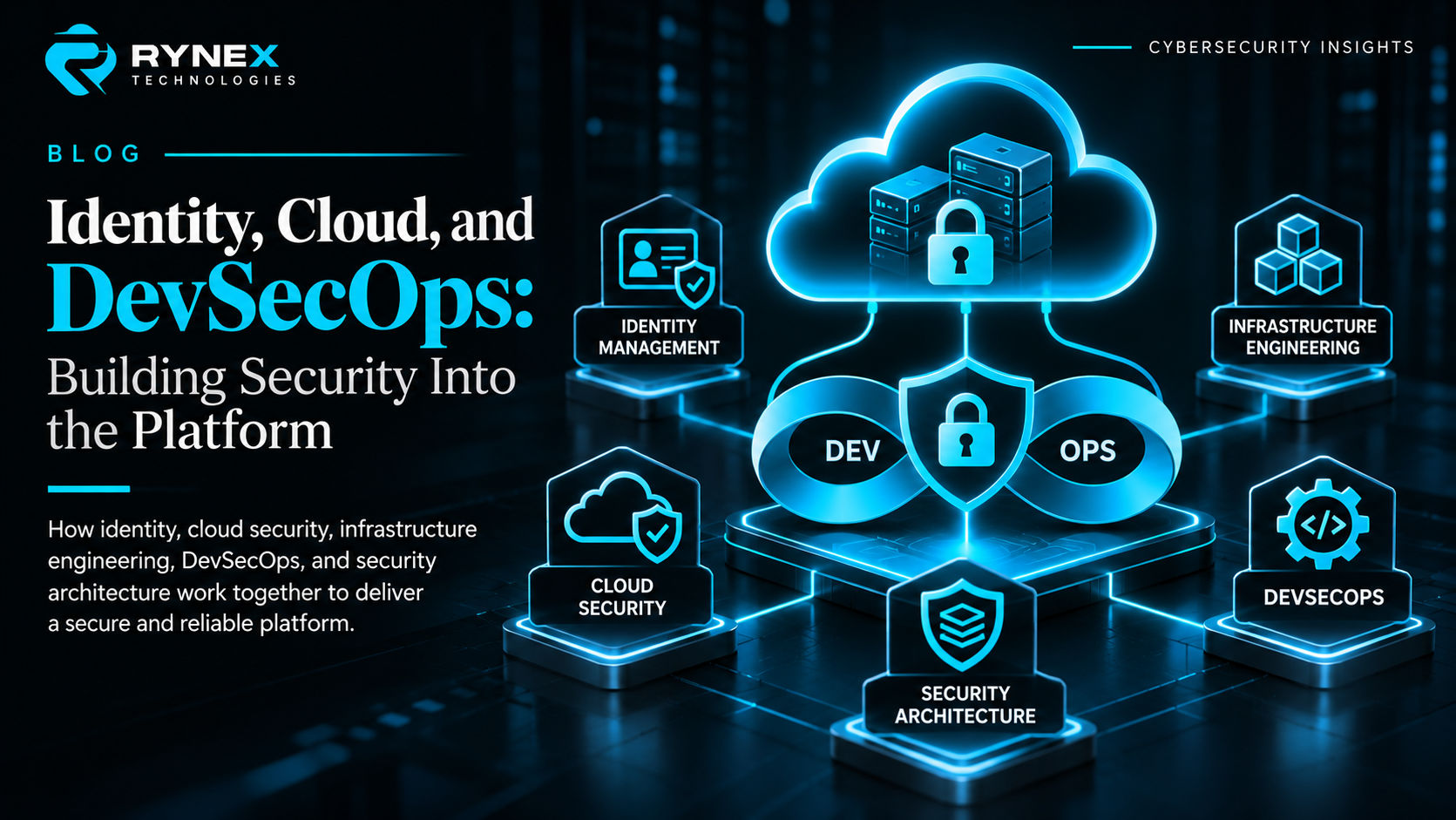
Identity, Cloud, and DevSecOps: Building Security Into the Platform
A developer merges a change. A pipeline builds the application, retrieves credentials, creates cloud resources, and deploys a new service. The service then uses its own identity to reach a database and a message queue.
Nothing about that sequence looks unusual. It is the everyday machinery of modern software delivery. But it crosses several security boundaries: a person approves code, automation receives authority, infrastructure is changed, and a workload accesses data.
If those boundaries are designed independently, the gaps between them become the risk. A developer account may have more access than it needs. A pipeline secret may live longer than the job that uses it. A cloud storage service may be public by default. A production workload may inherit a broad role because it was convenient during setup.
The way to prevent these problems is not to bolt on one more scanner. It is to connect identity management, cloud security, infrastructure engineering, DevSecOps, and security architecture around a shared idea: every person, service, and automation process should have only the authority it needs, for only as long as it needs it, with enough visibility to understand what it did.
What's inside
- Five disciplines, one platform
- Identity is the control plane
- Cloud security starts with architecture
- Infrastructure as code makes controls repeatable
- DevSecOps connects the design to delivery
- A secure deployment, end to end
- A practical way to get started
- Key takeaways
- Sources and further reading
Five disciplines, one platform
These terms are often presented as separate programs. In a working engineering organization, they are connected layers of the same platform.
| Discipline | The question it answers | What it contributes |
|---|---|---|
| Identity management | Who—or what—is making this request, and what may it do? | Authentication, authorization, lifecycle management, and accountability. |
| Cloud security | How are cloud services, data, and control planes protected? | Guardrails for accounts, networks, storage, keys, workloads, and monitoring. |
| Infrastructure engineering | How are the environments that run software created and operated? | Reliable provisioning, configuration, patching, segmentation, and recovery. |
| DevSecOps | How can security become part of the normal delivery process? | Automated checks and feedback integrated into development, build, release, and operations. |
| Security architecture | How should the system be structured to manage risk? | Trust boundaries, security requirements, control choices, and trade-off decisions. |
Security architecture provides direction. Identity defines who can cross a boundary. Infrastructure implements the environment. DevSecOps applies repeatable checks as changes move through it. Cloud security supplies platform-specific protections and visibility.
The goal is not to make every team responsible for every security task. It is to make ownership clear and the handoffs safe.
Note: Clear ownership helps prevent security work from falling between teams when systems or responsibilities change.
Identity is the control plane
Cloud infrastructure is changed through APIs, and applications increasingly call other services directly. In both cases, identity determines what is possible. A network boundary still matters, but it is not enough to establish trust on its own.
Note: A workload identity is the digital identity assigned to an application, service, or pipeline so it can authenticate without borrowing a person's credentials.
Treat people, workloads, and automation as identities
Human users are only one part of the identity landscape. A complete inventory also includes:
- Workloads that call databases, queues, storage, or other APIs.
- Build and deployment jobs that publish artifacts or change infrastructure.
- Operators and support personnel with elevated access.
- Vendors and integrations that connect to internal services.
Each identity should have a named owner, a clear purpose, and a defined lifecycle. Unowned service accounts and forgotten credentials accumulate because nobody is responsible for reviewing or removing them.
Prefer short-lived, scoped authority
Long-lived access keys are convenient because they keep working. That is also their weakness: once copied or exposed, they may remain useful until someone discovers and revokes them.
Where available, use federation or workload identity to exchange a trusted, short-lived assertion for narrowly scoped access. Constrain that trust: a pipeline should not receive production deployment rights merely because it belongs to the same organization. Consider the repository, branch, environment, workflow, and approval conditions that must be satisfied.
For human administrators, use multi-factor authentication, separate everyday accounts from privileged accounts, and grant elevated access just in time where practical. Review grants regularly, especially after role changes, project completion, or staff departure.
Make authorization understandable
Least privilege is difficult to maintain when permissions are broad, inherited through many groups, or expressed in policies nobody can explain. Prefer roles tied to job functions and workloads, keep production access distinct from development access, and document why unusual permissions exist.
A useful review asks more than “Is this user trusted?” It asks:
- What resource is being accessed?
- What action is required?
- Which identity is making the request?
- Under what conditions should the request be allowed?
- How will the action be logged and reviewed?
That is a practical form of zero-trust thinking: evaluate access based on identity, context, and policy rather than assuming that a request is safe because it came from inside a network.
Cloud security starts with architecture
Cloud providers secure parts of the platform, but customers remain responsible for how they configure and use those services. The exact division varies by service model. A managed database and a virtual machine do not transfer the same responsibilities to the provider.
Note: In general, the provider protects the underlying cloud platform, while customers remain responsible for how they configure access, data, and workloads.
Architecture is where those responsibilities become concrete. Before deployment, identify:
- Data: what is stored or processed, how sensitive it is, and where it may reside.
- Trust boundaries: which users, networks, services, and providers can interact.
- Entry points: public endpoints, administrative interfaces, deployment systems, and integrations.
- Failure modes: what happens if a credential is compromised, a region is unavailable, or a dependency is malicious.
- Recovery needs: what must be restored, in what order, and how integrity will be checked.
From those answers, the team can choose meaningful controls: private service endpoints, network segmentation, encryption and key ownership, account separation, centralized audit logs, backup protection, and alerting for sensitive control-plane actions.
The best control depends on the system. A rule that blocks every public connection may be appropriate for a database, but it could make no sense for a public website. Architecture translates broad security principles into system-specific decisions and explains the trade-offs.
Infrastructure as code makes controls repeatable
Infrastructure as code (IaC) lets teams review and version changes to cloud resources just as they review application code. That creates a chance to prevent insecure configurations before they reach production.
Note: IaC describes infrastructure in files that can be reviewed, versioned, tested, and applied consistently.
Useful practices include:
- Keep infrastructure definitions in version control with peer review and protected release paths.
- Use maintained, versioned modules rather than copying unreviewed examples between projects.
- Check for risky settings such as public storage, overly broad network rules, missing encryption, or permissive identity policies.
- Apply policy-as-code to enforce organization-wide requirements consistently.
- Separate plan, approval, and apply permissions, especially for production changes.
- Protect state files and plan outputs; they may contain sensitive values even when the source code does not.
- Detect configuration drift and route exceptions to an owner with an expiration or remediation plan.
Automated checks are guardrails, not proof that a design is secure. A scanner may not understand whether public access is intentional, whether a role is too broad for a particular workload, or whether a backup can actually be restored. Pair automation with review that understands the context.
DevSecOps connects the design to delivery
DevSecOps is sometimes reduced to “put security tools in the CI pipeline.” Tools help, but the larger goal is to give teams fast, actionable security feedback while preserving a dependable release process.
Note: DevSecOps is a way of working security into development and operations—not a single tool or pipeline stage.
A mature delivery path can include checks at several points:
- Design: record security requirements, data flows, and trust boundaries for higher-risk changes.
- Code: review authorization logic, input handling, error behavior, and sensitive-data handling.
- Dependencies: identify vulnerable or untrusted packages, containers, and build tools; define how findings are prioritized and fixed.
- Build: protect the build environment, handle secrets safely, and produce artifacts with traceable provenance.
- Infrastructure: validate IaC and policy before applying changes.
- Release: require appropriate approvals and limit who or what can deploy to production.
- Runtime: monitor security-relevant events, configuration changes, and workload behavior; feed incidents back into engineering.
Not every check should block every release. A low-confidence warning may need triage; a confirmed critical exposure may justify stopping deployment. Teams should define severity, ownership, response times, and exception handling instead of leaving developers to guess.
Secrets deserve special treatment. Avoid placing credentials in source code, build logs, container images, or artifacts. Prefer retrieving secrets at runtime using a workload identity, restrict who can access them, rotate them when exposure is suspected, and monitor their use. Secret scanning is useful, but prevention and access design reduce the damage when a scan misses something.
A secure deployment, end to end
Imagine a team deploying a customer-facing service to a cloud environment.
The architecture defines which data the service handles, which dependencies it calls, what must remain private, and what recovery time is acceptable. The workload receives its own identity with permission to access only its database and message queue. Developers authenticate through the organization's identity provider, while production administration requires stronger controls and a separate approval path.
When a change is merged, the pipeline uses federation to obtain short-lived deployment authority. That authority is restricted to the approved repository and production environment. The pipeline builds a versioned artifact, checks dependencies, validates infrastructure definitions, and records enough metadata to trace what was deployed and from which source revision.
Infrastructure changes pass policy checks and review before application. Production resources are separated from development resources, sensitive storage is not publicly reachable by default, and audit events are sent to a protected central location. The running service emits security-relevant events without logging passwords, tokens, or unnecessary personal data.
If an unusual permission change or access pattern appears, monitoring gives responders a way to investigate. They can identify the responsible identity, revoke or constrain access, determine the affected resources, and link the event to a deployment or operator action. The results then inform a code change, a policy update, or a better alert.
No single tool provides this outcome. It comes from a set of architectural choices that remain connected from a developer's change to the production system and back again.
A practical way to get started
If these disciplines are currently disconnected, do not begin by buying a larger platform. Start with a critical service and make its security model visible.
- Map identities and permissions. Include people, workloads, vendors, and automation. Find shared, dormant, ownerless, and long-lived credentials.
- Draw the service's trust boundaries. Show where data flows, which interfaces are public, and which components can make privileged changes.
- Choose a few architectural requirements. For example: no public access to sensitive data stores, no static production credentials in CI, and centralized logs for privileged changes.
- Encode repeatable requirements. Put infrastructure and policy checks in version control and make their failures actionable.
- Clarify the delivery path. Identify who can approve, build, and deploy; protect production environments and artifacts accordingly.
- Test recovery and visibility. Confirm that alerts reach an owner, access can be revoked, and backups can be restored.
- Review exceptions and improve. Give exceptions an owner, a reason, and a review date. Use incidents and near misses to update the design.
The useful measure is not how many controls exist. It is whether the organization can explain who has access, how changes reach production, what happens when a control fails, and how it will know.
Key takeaways
- Identity is central to cloud access because people, workloads, and pipelines all act through credentials and permissions.
- Security architecture connects business needs and threat boundaries to concrete platform controls.
- Infrastructure as code makes configuration reviewable and repeatable, but still needs contextual review and runtime verification.
- DevSecOps is a feedback system across design, code, build, release, and operations—not just a scanner in CI.
- Short-lived credentials, least privilege, protected production paths, and useful audit trails reduce both attack opportunity and investigation time.
- Start with one important service, make its identities and trust boundaries visible, and improve the system incrementally.
When identity, cloud controls, infrastructure, and delivery are designed together, security becomes part of how the platform works—not a checklist applied after it is built.